

THE DEVELOPMENT OF RADAR EQUIPMENTS FOR THE ROYAL NAVY, 1935-45
Written by F.A. Kingsley
Published by Macmillan Press Ltd
in 1995
ISBN: 9781349134595
- Categorised in:
- MILITARY
- RADIO TECHNICAL
- NAVY
- SCIENCE AND TECHNOLOGY
- MARITIME
- WORLD WAR II
 View more images
THE DEVELOPMENT OF RADAR EQUIPMENTS FOR THE ROYAL NAVY, 1935-45
Written by F.A. Kingsley.
Stock no. 1829897
1st.
1995.
Softcover.
Nearly fine condition.
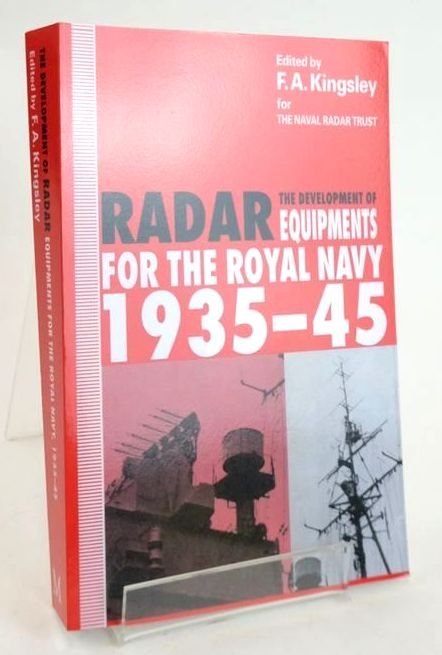
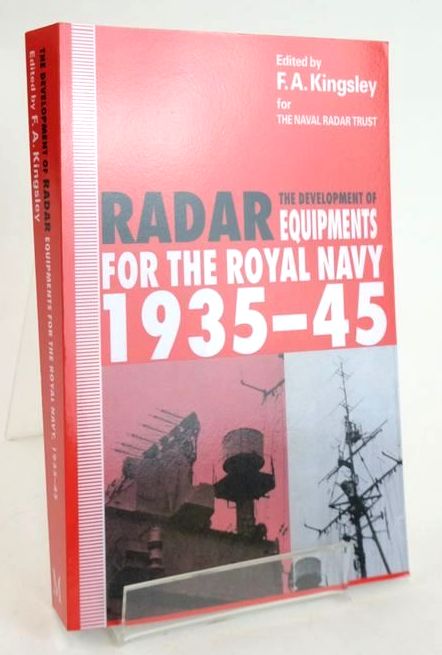
This book contains a series of technical monographs dealing with various aspects of British Naval radar from its inception in 1935 until the end of World War 2. Red pictorial cardwraps. B/w photos and drawings. xl and 476 pages including index. A physical print on demand copy, printed by Lightning Source UK Ltd. ISBN: 9781349134595. A lovely copy, appears unread!
Front cover
Contents
- List of Illustrations
- List of Tables
- Preface
- Tribute - Cecil Horton - Father of British Naval Radar
- Development and Installation of British Naval Radar - Some Significant Milestones
- Notes on the Contributors
- PART I RADAR EQUIPMENT DEVELOPMENTS, 1935-45
- Editorial Note
- 1 The Origins and Development of Radar in the Royal Navy, 1935-1945, with Particular Reference to Decimetric Gunnery Equipments
- JF Coales
- Summary
- Introduction
- The research background, 1915-35
- The formative years, 1935-37
- The 1937 reorganisation of Naval radar research
- Preparing for War, 1938-9
- Early developments in 50-cm radar equipment
- Wartime developments
- The need for a surface detection capability
- The small-ship radar requirement, 1940
- The requirement for gunnery and fire-control radar (50cm)
- Development of Naval gunnery and fire-control radar systems
- Trails of main armament and high-angle director radars
- The birth of Naval 10-cm radar
- The application of 10-cm radar in the U-boat war
- Parallel developments
- Gunnery radar developments and improvements, 1942 onwards
- 2 Basic Science and Research for Naval Radar, 1935-1945
- BW Lythall
- Summary
- Early history - and two missed opportunities
- The invention of radar
- The multiple-cavity anode magnetron
- The environment for research
- 1938-42
- 1942-5
- The patterns of research
- Research themes
- The need to predict performance
- Early methods of height estimation
- Research on the radar environment
- Interference with the environment:anti-jamming research
- Interaction between theory and experiment
- 3 Valve Developments for Naval Radar Applications, 1935-45
- FM Foley
- Summary
- Introduction
- Early history of the valve section, HM Signal school
- Silica as a valve-envelope material
- Silica-valve technology
- Silica valves for radio transmitters
- Silica valves for radar
- Output power valves
- Pulse modulators
- Low-Power RF valves
- Mixers
- General-purpose valves
- Cahtode ray valves
- Appendix 1 HM Signal School Staff working on valve development up to 1945
- Appendix 2 Silica valve types
- 4 Royal Navy Metric Warning Radar, 1935-45
- JS Shayler
- Summary
- Introduction
- Types 79X and 79Y
- Type 79Z
- Type 279
- Types 79B/279B
- Type 281
- Type 281B
- Type 281BQ
- Type 286
- Type 290
- Type 291
- Type 960
- Postscript
- Appendices
- 5 Development of Naval Warning and Tactical Radar Operating in the 10cm band, 1940-45
- CA Cochrane
- Summary
- Preface
- Introduction
- Origins of the first Naval cm-radar
- The first operational centimetric radar
- Technical constraints and characteristics of Type 271X
- In the wake of HMS Orchis
- Coast and harbour defence applications
- Types 271,272, 273 in service, 1941-2
- Anti-submarine range performance of 5KW centimetric radar
- The High power magnetrons
- The Mark 4 development: Types 271Q and 273Q
- the Mark 5 development
- The Mark 5 experimental shore trails - Type 277T
- The Mark 5 experimental shipborne radar - Type 277X
- Sea reflection and target indication Types 276 and 293
- WS Tactical radar - low air warning - heightfinding - Type 277
- Further development of Type 277 - Types 277P and 277Q
- Centimetric fighter direction (FD) radar
- Revised proposals for FD radar
- The unknown factor in Type 980 (982) performance
- Conclusions
- Appendices
- 6 The Royal Navy and IFF - Identification Friend or Foe, 1935-45
- JS Shayler
- Summary
- Introduction
- The Beginning
- IFF Mark I
- IFF Mark II
- IFF Mark III
- IFF Mark IV
- IFF Mark V
- Postscript
- PART II RADAR SHIP-FITTING AND MAINTENANCE 1939-45
- Editorial Note
- 7 Radar Ship-Fitting and Maintenance in the Royal Navy 1939-45: Experience at Scapa Flow, May 1940 to April 1942
- BGH Rowley
- Summary
- Appointment to HM Signal School
- Appointment to the staff in C-in-C, Home Fleet
- Scapa Flow
- Expanding activities
- Summer 1940
- Autumn 1940
- Early 1941
- Summer 1941
- Early 1942
- 8 Radar Maintenance at Sea: A Personal Story, 1940-5
- RA Laws
- Summary
- Introduction
- Author's radar experience
- Personnel
- Fitting out and commissioning
- Acceptance of a new ship
- At sea
- handbooks and test gear
- Spares
- Calibration and setting up
- Preventative maintenance
- Malfunctions
- Breakdowns
- Modifications
- Ancillary services
- Tribute to the service
- Appendices
- 9 Naval Radar, Fitting Policy, Materiel Procurement, Installation, Sea-Trials and Shore-Based Maintenance
- AM Patrick
- Summary
- Introduction
- Formulation of Admiralty radar-fitting policy and programmes
- Procurement of radar equipment
- From Naval Stores to dockyards/shipyards
- The ship fitting-out task, 1939-45 an overview
- Pre-fitting work on-board ship
- Radar installation, testing and trials
- The Port Radar Officer Organisation
- The Radar officer organisation
- Conclusion
- Postscript
- Appendices
- Glossary
- Bibliography
- Index