
Beeswax - Part One - The History of Beeswax
Beeswax is a remarkable substance and is the only animal-based wax. All others are plant based.
Beeswax and History
I knew beeswax had been used for a long time but did not realise for how long. By 3000BC there was already established technology involving the use of large quantities of wax. In ancient Egypt it was used for embalming and modelling; exquisite examples of cats and eagles among other waxen figures have been recovered from graves and from the pyramids.
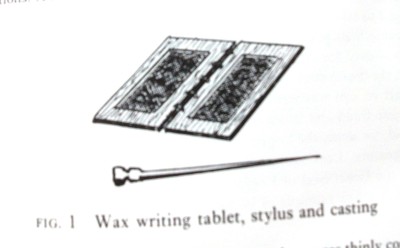
Catullus spoke of the ancient Roman love letters system by exchange of wax tablets. The recipient rubbed out the message and wrote the reply on the smoothed sheet of wax usually using a diptycha and stylus. How sensible, with no evidence left behind for blackmail or breach of promise! The diptycha is a pair of facing light wooden pages thinly coated with beeswax and hinged together. The stylus was often made of carved ivory, with a sharp point for writing at one end and a broad chisel shape at the other for rubbing out.
The pagan gods of ancient Rome, as well as Buddha in Ceylon, had candles lit in their honour, and the Christian use of candles was and is part of a much older tradition.
When the Romas conquered Corsica in 181 B.C., they imposed an annual tax of 100,000lb of beeswax, and there are many records up to recent times of rents and taxes being paid in fixed amounts of beeswax. Even though abbeys and monasteries kept bees themselves, tithes and rents were commonly set at so many pounds of beeswax, a durable commodity of constant value.
The use of sealing wax also goes back to at least Roman times. A signet ring with a clear pattern imposed by a unique mould was used for centuries as a guarantee of authenticity and proof that the document expressed the will of the owner of the seal. The seal was jealously guarded, or worn on the person, to prevent fraud and unauthorized use. When most people could not write, the impression of their seal was the equivalent of a signature.
Of all the many uses of wax over the centuries, perhaps the greatest has been in candles. From the 4th century the Christian Church has attached a special significance to candles made of beeswax. To this day the paschal candle plays a significant role during the 40 days between Easter and the Feast of Ascension and is finally extinguished after the Gospel of this Feast.
The Wax Chandlers
So far as Britain is concerned, the history of Beeswax is interwoven with that of the Worshipful Company of Wax Chandlers, incorporated by Royal Charter of King Richard III in 1484 but active for a century or more before this. Of the current 113 Livery Companies in the City of London, the Wax Chandlers rank twentieth, the position they have held since 1515 when the ranking was established.
In medieval times artificial light, apart from that given by log fires, was by candles of one sort or another. The very poor had none, except for cheap tallow candles made from mutton fat, burning with a smoky flame and an unpleasant smell. Those less poor had rushlights, made by dipping thin hollow reeds in molten beeswax, when the central pith of the reed stem absorbed the wax and acted as a wick. The well-to-do had beeswax candles and the nobility and very wealthy had branched candelabra burning three, five or even more candles at a time, giving a good light and a pleasant aroma.
Thus, the Wax Chandlers had a virtual monopoly of artificial light. Their business was to process and sell beeswax, to make and sell candles and other wax products. This business went on virtually unchanged for centuries, until the introduction of paraffin wax and oil lamps in the 19th century.
In past centuries the production of wax candles was big business, not only for everyday use but on state occasions and for churches. However, the Reformation was getting under way and the ‘Church Candle Business’ suffered as Rood screens were destroyed, altars simplified, and monasteries taken over in the 1530s and 1540s. At one stage, during this time, wax candles in church were forbidden except for necessary provision of light, i.e. not allowed on altars. This seemed to have lapsed by 1588 when a gigantic paschal candle weighing 300lb was set up in Westminster Abbey. Later, Cromwell and his edicts forbade the use of altar candles, wax effigies of persons and angels etc, so that a lucrative church trade was once again curtailed.
On 4th September 1666 the Great Fire of London, destroyed 13000 houses and 87 churches including St Paul’s Cathedral. Forty-four Company Halls, including the Wax Chandlers were also destroyed. The same hall was burnt out again in 1940 by enemy bombing as well as the altar in St Paul’s Cathedral. The hall was rebuilt in 1958 and is still in use today.
The Process of Beeswax Production
Although beeswax has been a familiar article of commerce for three or four thousand years, it is only in the last two hundred years or so that anyone has had a clear idea of its origin, apart from the fact that the bees were responsible for it.
We now know how wax is produced and the chemistry behind it:
- Bees consume large amounts of honey to fuel the production of wax. It is estimated that it takes approximately 6 to 8 pounds of honey to produce 1 pound of wax. Mind blowingly, it would take about 10,000 bees three days to produce that one pound of wax!
- The Bees cluster together to maintain a temperature of around 33-36 degrees Celsius. This keeps the wax pliable while they build the honeycomb
- Beeswax is produced from special glands in their abdomens called wax glands. These glands secrete a liquid substance that initially emerges as a clear, colourless liquid.
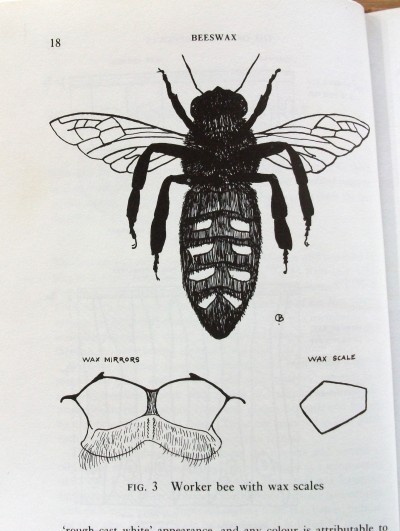
- The wax glands become active when a worker bee is about 10-20 days old
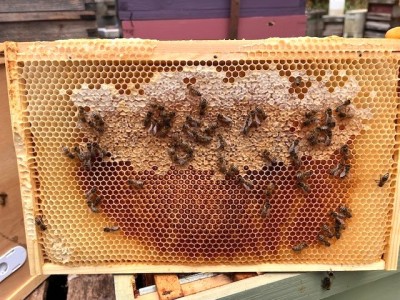
- Other worker bees collect the wax flakes and take them to the parts of the hive that need new wax. Bees chew the wax flakes to soften them, then use their mandibles to mould the wax into the desired shape, creating hexagonal cells.
- Upon contact with air, it hardens into small, wax scales about the size of a pinhead. Bees use these scales to build the iconic hexagonal cells of the honeycomb structure. These cells serve as storage for honey, pollen, and developing bees.
- The hexagon is the most space-efficient way to pack cells together, giving strength to the structure and requiring the least amount of wax.
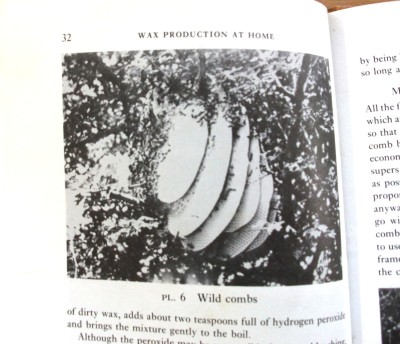
I hope you enjoyed this little foray into the history of this amazing substance created by these even more amazing little creatures. Part 2 “The Chemistry of Beeswax” to follow soon.
Gleanings from:
Beeswax by Ron Brown
Contributed by Bernice
(Published on 9th Sep 2025)