
Stella and Rose's Books Logo

Stella & Rose's Books

Specialists in Rare & Collectable Books

  Basket is empty
  Login Register

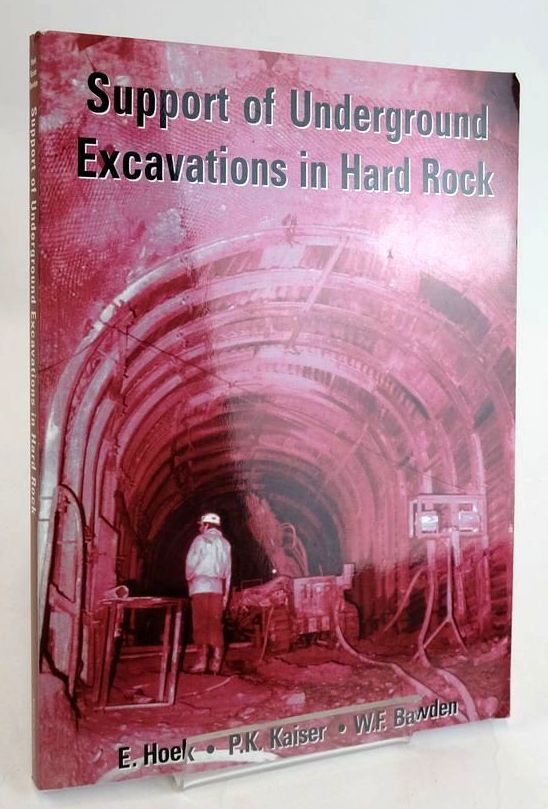
SUPPORT OF UNDERGROUND EXCAVATIONS IN HARD ROCK

by E. Hoek; P.K. Kaiser; W.F. Bawden

Published by Taylor & Francis. 2006

Very good condition. The safe and economical construction of tunnels, underground mining excavations and underground power caverns depends upon a large number of factors, one of which is the correct choice of support systems to ensure that the excavations remain stable. This book deals with the investigations required to establish support requirements, with the methods which are used to design support systems and with many of the practical details of correct support installation. Large format. Pictorial cardwraps. B/w illustrations and diagrams. XII and 215 pages including index. Digitally printed.

A few minor marks and scuffs to covers. Corners lightly rubbed. Top of spine knocked. Contents clean.

ISBN: 9054101873
Stock no. 1830440

Buy now for £24.00 Enquire about this book Add to Wish List

Contents

  • Foreword
  • Preface
  • 1 An Overview of Rock Support Design
  • 1.1 Introduction
  • 1.2. Stages in mine-development
  • 1.2.1 Exploration and preliminary design
  • 1.2.2 Mine design
  • 1.2.3 Early years of mining
  • 1.2.4 Later years of mining
  • 1.3 Support design
  • 2 Assessing acceptable risks in design
  • 2.1 Introduction
  • 2.2 Factor of safety
  • 2.3 Sensitivity studies
  • 2.4 The application of probability to design
  • 2.5 Probability of failure
  • 2.6 Problems to which probability cannot be applied
  • 3 Evaluation of engineering geological data
  • 3.1 Introduction
  • 3.2 Engineering geological data collection
  • 3.3 Structural geological terms
  • 3.4 Structural geological data collection
  • 3.5 Structural geological data presentation
  • 3.6 Geological data analysis
  • 4 Rock mass classification
  • 4.1 Introduction
  • 4.2 Engineering rock mas classification
  • 4.2.1 Terzaghi's rock mass classification
  • 4.2.2 Classifications involving stand-up time
  • 4.2.3 Rock quality designation index (RDQ)
  • 4.2.4 Rock structure rating (RSR)
  • 4.3 Geomechanics classification
  • 4.4 Modifications to RMR for mining
  • 4.5 Rock tunnelling quality index, Q
  • 4.6 Using rock mass classification systems
  • 4.7 Estimation of in situ deformation modulus
  • 5 Shear strength of discontinuities
  • 5.1 Introduction
  • 5.2 Shear strength of planar surfaces
  • 5.3 Shear strength of rough surfaces
  • 5.3.1 Field estimates of JRC
  • 5.3.2 Field estimates of JCS
  • 5.3.3 Influence of scale on JRC and JCS
  • 5.4 Shear strength of filled discontinuities
  • 5.5 Influence of water pressure
  • 5.6 Instantaneous cohesion and friction
  • 6 Analysis of structurally controlled instability
  • 6.1 Introduction
  • 6.2 Identification of potential wedges
  • 6.3 Support to control wedge failure
  • 6.3.1 Rock bolting wedges
  • 6.3.2 Shotcrete support for wedges
  • 6.4 Consideration of excavation sequence
  • 6.5 Application of probability theory
  • 7 In situ and induced stresses
  • 7.1 Introduction
  • 7.2 In situ stresses
  • 7.2.1 The World Stress Map
  • 7.2.2 Developing a stress measuring programme
  • 7.3 Analysis of induced stresses
  • 7.3.1 Numerical methods of stress analysis
  • 7.3.2 Two-dimensional and three-dimensional models
  • 7.3.3 Stress analysis using the program PHASES
  • 8 Strength of rock and rock masses
  • 8.1 Introduction
  • 8.2 Definition of the problem
  • 8.3 Strength of intact rock
  • 8.4 The strength of jointed rock masses
  • 8.5 Use of rock mass classifications for estimating GSI
  • 8.6 When to use the Hoek-Brown Failure criterion
  • 9 Support design for overstressed rock
  • 9.1 Introduction
  • 9.2 Support interaction analysis
  • 9.2.1 Definition of failure criterion
  • 9.2.2 Analysis for tunnel behaviour
  • 9.2.3 Deformation of an unsupported tunnel
  • 9.2.4 Deformation characteristics of support
  • 9.2.5 Estimates of support capacity
  • 9.2.6 Support interaction example
  • 9.3 The PHASES program
  • 9.3.1 Support interaction analysis using PHASES
  • 10 Progressive spalling in massive brittle rock
  • 10.1 Introduction
  • 10.2 Examples of spalling in underground excavations
  • 10.3 the AECL Underground Research Laboratory
  • 10.3.1 In situ stresses at 420 level
  • 10.3.2 Properties of Lac du Bonnet granite
  • 10.3.3 URL Rooms 413 and 405
  • 10.3.4 URL Test tunnel
  • 10.4 Example from El Teniente Mine, Chile
  • 10.5 South African experience
  • 10.6 Implications for support design
  • 10.6.1 Rockbolting
  • 10.6.2 Shotcrete
  • 10.6.3 Discussion
  • 11 Typical support applications
  • 11.1 Introduction
  • 11.2 'Safety' support systems
  • 11.3 Permanent mining excavations
  • 11.4 Drawpoints and orepasses
  • 11.5 Small openings in blocky rock
  • 11.6 Small openings in heavily jointed rock
  • 11.7 Pre-support of openings
  • 11.7.1 Cut and fill stope support
  • 11.7.2 Pre-reinforcement of permanent openings
  • 11.7.3 Reinforcement of non-entry stopes
  • 12 Rockbolts and dowels
  • 12.1 Introduction
  • 12.2 Rockbolts
  • 12.2.1 Mechanically anchored rockbolts
  • 12.2.2 Resin anchored rockbolts
  • 12.3 Dowels
  • 12.3.1 Grouted dowels
  • 12.3.2 Friction dowels of 'Split Set' stabilisers
  • 12.3.3 'Swellex' dowels
  • 12.4 Load-deformation characteristics
  • 13 Cablebolt reinforcement
  • 13.1 Introduction
  • 13.2 Cablebolt hardware
  • 13.3 Cablebolt bond strength
  • 13.4 Grouts and grouting
  • 13.5 Cablebolt installation
  • 13.6 Modified cablebolts
  • 14 The Stability Graph method
  • 14.1 Introduction
  • 14.2 The Stability Graph method
  • 14.2.1 The stability number, N
  • 14.2.2 The shape factor, S
  • 14.2.3 The stability graph
  • 14.3 Cablebolt design
  • 14.4 Discussion of the method
  • 14.5 Worked stability graph example
  • 14.5.1 Structural geology
  • 14.5.2 Q' classification
  • 14.5.3 Preliminary stope design
  • 15 Shotcrete support
  • 15.1 Introduction
  • 15.2 Shotcrete technology
  • 15.2.1 Dry mix shotcrete
  • 15.2.2 Wet mix shotcrete
  • 15.2.3 Steel fibre reinforced microsilica shotcrete
  • 15.2.4 Mesh reinforced shotcrete
  • 15.3 Shotcrete application
  • 15.4 Design of shotcrete support
  • References
  • Software Information
  • Author Index
  • Subject Index

Similar Stock