

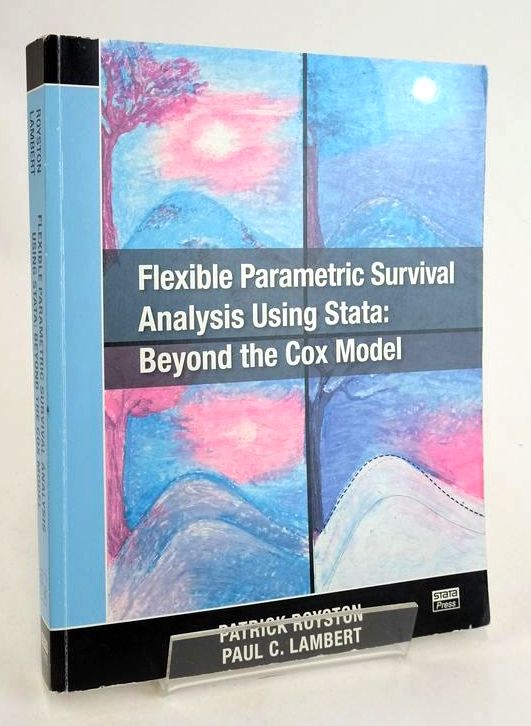
FLEXIBLE PARAMETRIC SURVIVAL ANALYSIS USING STATA: BEYOND THE COX MODEL
Written by Patrick Royston, Paul C. Lambert
Published by Stata Press
in 2011
ISBN: 9781597180795
- Categorised in:
- MATHS
- SCIENCE AND TECHNOLOGY
- STATISTICS
- MEDICAL
Sorry but we don't currently have any copies of this book in stock. If you would like to contact us we can let you know the moment we get one in stock.
Front cover
Contents
- List of Tables
- List of Figures
- Preface
- 1 Introduction
- 1.1 Goals
- 1.2 A brief review of the Cox proportional hazards model
- 1.3 Beyond the Cox Model
- 1.4 Why parametric models?
- 1.5 Why not standard parametric models?
- 1.6 A brief introduction to stpm2
- 1.7 Basic relationships in survival analysis
- 1.8 Comparing models
- 1.9 The delta method
- 1.10 Ado-file resources
- 1.11 How our book is organised
- 2 Using stset and stsplit
- 2.1 What is the stset command?
- 2.2 Some key concepts
- 2.3 Syntax of the stset command
- 2.4 Variables created by the stset command
- 2.5 Examples of using stset
- 2.6 The stsplit command
- 1.7 Conclusion
- 3 Graphical introduction to the principal datasets
- 3.1 Introduction
- 3.2 Rotterdam breast cancer data
- 3.3 England and Wales breast cancel data
- 3.4 Orchiectomy data
- 3.5 Conclusion
- 4. Poisson models
- 4.1 Introduction
- 4.2 Modelling rates with the Poisson distribution
- 4.3 Splitting the time scale
- 4.4 Collapsing the data to speed up computation
- 4.5 Spitting at unique failure times
- 4.6 Comparing a different number of intervals
- 4.7 Fine splitting of the time scale
- 4.8 Splines: Motivation and definition
- 4.9 FP's: Motivation and definition
- 4.10 Discussion
- 5 Royston-Parmar models
- 5.1 Motivation and introduction
- 5.2 Proportional hazards models
- 5.3 Selecting a spline function
- 5.4 PO Models
- 5.5 Pribit models
- 5.6 Royston=Parmar (RP) models
- 5.7 Concluding remarks
- 6 Prognostic models
- 6.1 Introduction
- 6.2 Developing and reporting a prognostic model
- 6.3 What does the baseline
- 6.4 Model selection
- 6.5 Quantitative outputs from the model
- 6.6 Goodness of fit
- 6.7 Discrimination and explained variation
- 6.8 Out-of-Sample prediction: Concept and applications
- 6.9 Visualization of survival times
- 6.10 Discussion
- 7 Time-dependent effects
- 7.1 Introduction
- 7.2 Definitions
- 7.3 What do we mean by a TD effect?
- 7.4 Proportional on which scale?
- 7.5 Poisson models with TD effects
- 7.6 RP models with TD effects
- 7.7 TD effects for continuous variables
- 7.8 Attained age as the time scale
- 7.9 Multiple time scales
- 7.10 Prognostic models with TD effects
- 7.11 Discussion
- 8 Relative survival
- 8.1 Introduction
- 8.2 What is relative survival
- 8.3 Excess mortality and relative survival
- 8.4 Motivating example
- 8.5 Life-table estimation of relative survival
- 8.6 Poisson models for relative survival
- 8.7 RP models with relative survival
- 8.8 Some comments on model selection
- 8.9 Age as a continuous variable
- 8.10 Concluding remarks
- 9 Further topics
- 9.1 Introduction
- 9.2 Number needed to treat
- 9.3 Average and adjusted survival curves
- 9.4 Modelling distributions with RP models
- 9.5 Multiple events
- 9.6 Bayesian RP Models
- 9.7 Competing risks
- 9.8 Period analysis
- 9.9 Crude probability of death from relative survival models
- 9.10 Final remarks
- References
- Author Index
- Subject Index