Stella and Rose's Books Logo

Stella & Rose's Books

Specialists in Rare & Collectable Books

  Basket is empty
  Login Register

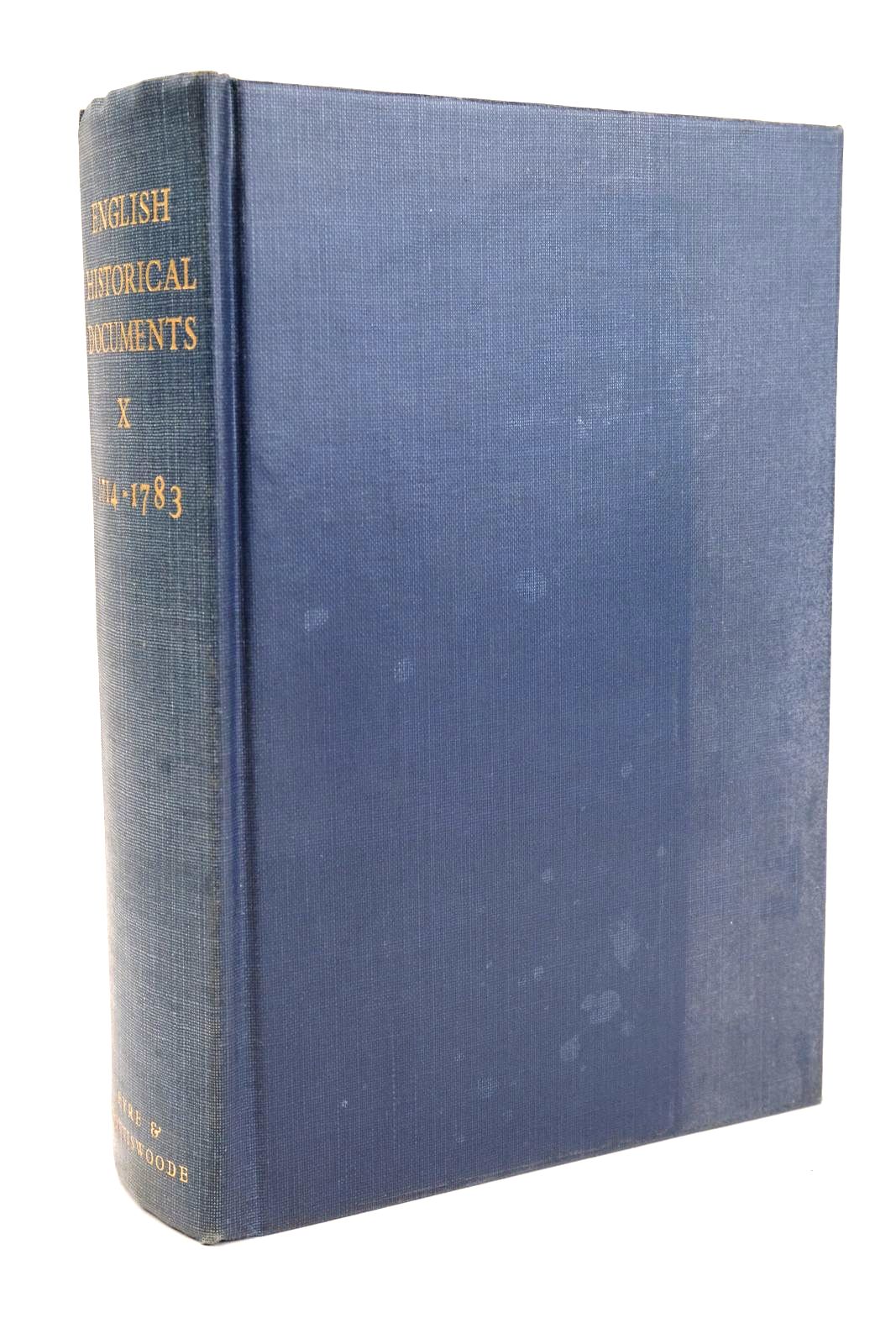
ENGLISH HISTORICAL DOCUMENTS VOLUME X 1714-1783

by D.B. Horn; Mary Ransome

Published by Eyre & Spottiswoode Limited. 1957

Good condition. Blue cloth, gilt title to spine. 972 pages.

Spine is faded and bumped. Front cover is lightly stained/marked, some light scuff marks to rear cover. Name and date in ink to front free-endpaper. Browning to endpapers and foxing to textblock.

Stock no. 1330897

Enquire about this book Add to Wish List

Contents

  • Part I. THE MONARCHY
  • Introduction to Part I
  • Bibliography
  • A. The Theory of the Constitution
  • 1. Sir William Blackstone on the mixed nature of the Constitution, 1765
  • 2. Jean Louis De Lolme's view of the stability of the English Constitution and the reasons for that stability, 1775
  • 3. David Hume on "Whether the British Government inclines more to Absolute Monarchy, or to a Republic", circa 1740
  • B. THE ROYAL FAMILY
  • 4. Lady Mary Wortley Montagu on the Character of George I
  • 5. George II and Queen Caroline on England and the English, 1735
  • 6. Lord Waldegrave on the Character of George II and of George III as Prince of Wales, 1758
  • 7. Nathaniel Wraxall on the Charter of George III
  • 8. The Royal Marriage Act, 1772
  • C. THE CROWN AND ITS MINISTERS
  • 9. Letter from the duke of Newcastle to Lord Chesterfield on the ministerial crisis of 1746, 18 February 1746
  • 10. Letters from Lord Hardwicke describing the ministerial crisis of 1757, June 1757
  • 11. The Grenville Ministry state the terms on which they are prepared to remain in office, 22 May 1765
  • 12. George III's view of the Grenville Ministry's behaviour to him, 1765
  • 13. Letter from George III to Lord Bute on the 'King's Friends' and the Rockingham Ministry, 10 January 1766
  • 14. Letters between George III and Lord North, June-November 1778
  • 15. Letters from George Selwyn on the ministerial negotiations of March 1782
  • 16. Letter from Lord North to George III insisting on resignation now that his ministry has lost the support of the House of Commons, 18 March 1782
  • 17. Memoranda By George III on the negotiations ending in his unwilling acceptance of the coalition of North and Fox, 30 March-1 April 1783
  • 18. Documents illustrating the fall of the Coalition government, December 1783
  • 19. Sir Robert Walpole as 'Prime Minister'
  • 20. The duke of Newcastle's proposals for increased solidarity amongst the members of the 'inner cabinet', 19 January 1745
  • 21. Letters between the duke of Newcastle and |Lord Hardwicke
  • 22. Extracts from the Diary of George Grenville, 1763-1764
  • 23. Two views of the collective responsibility of ministers, 1741 and 1778
  • 24. Speaker Onslow on the collective responsibility of ministers, circa 1765
  • 25. Speech by Alderman Oliver in the House of Commons on 'responsible' and ' secret' advisers, 27 November 1775
  • 26. The duke of Grafton disapproves of |Lord Shelburne's "view of becoming Prime Minister", 16 February 1783
  • 27. Speech by Lord Shelburne in the House of Lords censoring ministers for their conduct towards Ireland, 1 December 1779
  • Part II. PARLIAMENT
  • Introduction to Part |II
  • Bibliography
  • A. Summons, Duration and Composition
  • 28. Proclamation summoning the first Parliament of George I, 15 January 1715
  • 29. The Septennial Act, 1716
  • 30. Arguments for and against the Septennial Act, 1716
  • 31. The Peerage Bill, 1719
  • 32. A Place Act, 1743
  • 33. A Place Act (Members), 1782
  • 34. A Place Act (Electors), 1782
  • B. Proceedings
  • 35. Formal business in the House of Commons at the beginning of a session, 6 August 1714
  • 36. Horace Walpole's account of the different styles of oratory in the House of Commons, circa 1755
  • 37. Carl Philipp Moritz's description of the House of Commons, 1782
  • C. Privilege
  • 38. John Wilkes and The North Briton, 1763
  • 39. John Wilkes and the Middlesex Election, 1769
  • 40. Speeches by Sir William Windham and W9ill9iam Pulteney on the reporting of debates, 13 April 1738
  • 41. The Case of Brass Crosby, 1771
  • D. Elections
  • 42. Expenses of Sir Robert Kemp, Bart., in his son's election at Orford, 1730
  • 43. Extracts from the Diary of George Bubb Dodington, 1753-1754
  • 44. Election petitions, March 1738
  • 45. The Grenville Act, 1770
  • 46. Carl Philipp Moritz's description of an election, 1782
  • E. Political Parties
  • 47. An account of political parties at the accession of George I. 1714
  • 48. Letter from Lord Chesterfield to George Bubb Dodington
  • 49. A pamphlet on the wickedness of 'faction', 1761
  • 50. Speech by Lord Sandwich in the House of Lords, 22 November 1770
  • F. The Movement for Parliamentary Reform
  • 51. Speech by Lord Chatham in the House of Lords on parliamentary reform, 22 January 1770
  • 52. Major John Cartwright on the evils of long parliaments, 1776
  • 53. Petition and Resolutions of the Yorkshire Association, 1779-1780
  • 54. Letter from Lord Rockingham to Pemberton Milnes on parliamentary reform, 28 February 1780
  • 55. Letter from Lord Shelburne to the chairman of the Wilshire Committee, 26 March 1780
  • 56. The duke of Richmond's plan for parliamentary reform, 3 June 1780
  • 57. Prospectus and List of Members of the Society for Constitutional Information, 1780
  • 58. Speech by William Pitt in the House of Commons on parliamentary formation, 1780
  • 59. Speech by Edmund Burke in the House of Commons against Pitts proposal, 7 May 1782
  • Part III. THE LAW AND ITS ADMINISTRATION
  • A. The Law
  • B. Central Administration and the Keeping of Order
  • C. Local Government
  • Part IV. PUBLIC FINANCE
  • A. Revenue and Expenditure
  • B. Customs and Excise
  • C. Direct Taxes
  • D. Financial Administration
  • E. The National Debt
  • Par V. THE CHURCHES
  • A. Church and State
  • B. The Condition of the Church of England
  • (a) Ecclesiastical Revenues
  • (b) The Work of the Clergy
  • C. The Methodists
  • D. Non Conformity
  • (a) The Protestant Dissenters
  • (b) The Catholics
  • Part VI. THE STATE OF TE NATION: ECONOMIC
  • A. Agriculture
  • B. Industry
  • (a) Textiles
  • (b) The Midland Industries
  • (c) Mines
  • C. Combinations of Workmen
  • D. Trade
  • E. Some Population Statistics
  • Part VII. THE STATE OF THE NATION: SOCIAL
  • A. Social Life
  • B. Transport and Communications
  • C. Humanitarianism
  • D. Education
  • Part VIII. THE ARMED FORCES
  • A. The Navy
  • (a) Recruitment and General Conditions
  • (b) Administration
  • (c) Tactics and Fighting Instructions
  • B. The Army
  • (a) Recruitment, Discipline and General Conditions
  • (b) Unpopularity of a Standing Army
  • C. The Militia
  • Part IX. SCOTLAND
  • A. The Church
  • B. The Highlands and the Risings of 1715 and 1745
  • C. Scotland after 1745
  • Part X. IRELAND
  • A. Relations with England
  • B. Religion
  • C. Economic and Social Conditions
  • Part XI. THE COLONIES
  • A. Eighteenth-Century View on Colonies
  • B. Colonial Trade
  • C. General Organization
  • D. America
  • (a) The Thirteen Colonies
  • (b) The West Indies
  • (c) Canada
  • (d) Nova Scotia and Newfoundland
  • E. India
  • F. Africa
  • Part XII. FOREIGN POLICY AND WARS
  • A. Policy
  • B. Wars
  • (a) War of the Austrian Succession
  • (b) Seven Years War
  • (c) War of American Independence
  • C. Treaties
  • Appendices
  • Diagrams
  • Maps
  • Index to Texts

Similar Stock