

HEX: A PRINCELY ESTATE REVEALED
Written by Chris De Maegd
Published by Mercatorfonds
in 2007
ISBN: 9789061537465
- Categorised in:
- TOPOGRAPHY (FOREIGN)
- EUROPE
- BELGIUM
- GARDENS
- ARCHITECTURE
- HISTORY (EUROPEAN)
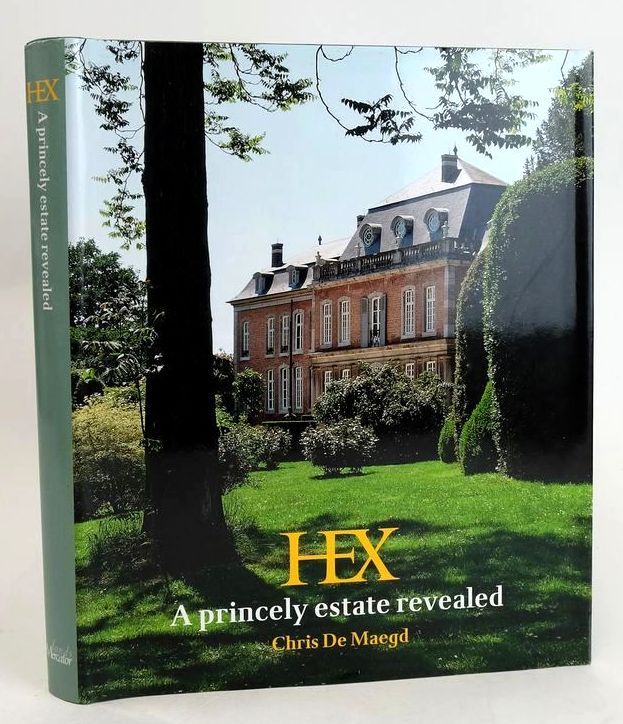
HEX: A PRINCELY ESTATE REVEALED
Written by Chris De Maegd.
Stock no. 1830250
1st.
2007.
Hardback.
Large format.
Nearly fine condition in a nearly fine dustwrapper.
The manor house at Hex, known locally in Belgium as Castle Hex, was built around the end of the 18th century by the then Prince-Bishop of Liege, Francois-Charles de Velbruck, as a summer residence and hunting lodge. The house is built in a style transitional between rococo and classical, with the gardens combining French formality with an English-style landscaped park beyond, to make a truly Arcadian setting. Here, the development of the house and grounds is revealed from its inception, through the wars and upheaval s of the 19th and 20th centuries, up to the present day. Large format. Green cloth boards, gilt titles. Colour photos. 223 pages including index. ISBN: 9789061537465. A lovely copy.
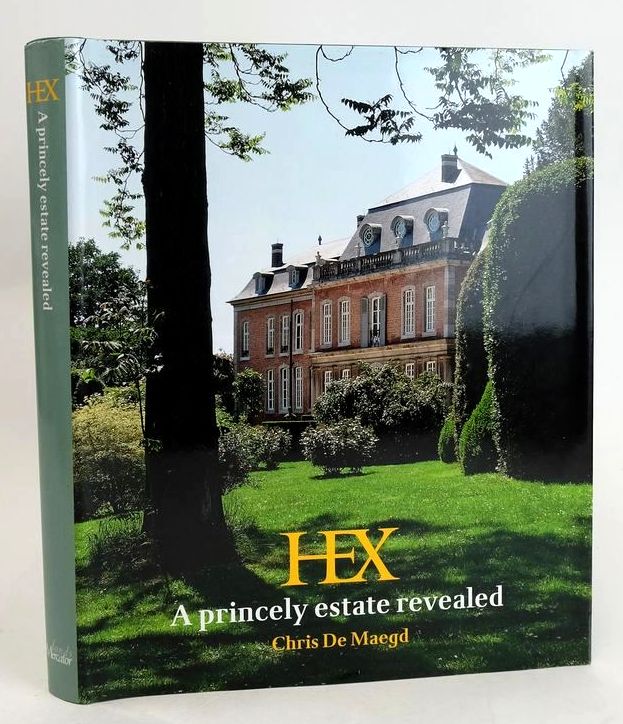
Front cover
Contents
- Foreword by Ghislain d'Ursel
- Introduction
- Acknowledgements
- 1 VELBRUCK, D'ANSEMBOURG, D'URSEL
- An enlightened Prince
- Joseph-Romain and Fanny d'Ansembourg
- Alfred I Frederic and Gustave d'Ansembourg
- d'Ansembourg, de Bousies, d'Ursel
- Line of Succession at Hex
- 2 THE ESTATE
- A hunting-seat for the Prince-Bishop
- Gentleman's Quarters
- The Ferraris map
- Star Wood
- Still a magnificent setting
- The structure of the estate
- The Cadastre
- 3 THE MANOR HOUSE
- Velbruck's country house in words and pictures
- Baron de Wal
- Philippe de Corswarem
- The hunting lodge
- the service wing
- The contributions of Joseph-Romain and Fanny d'Ansembourg
- Hex and Amstenrade
- Alfred I d'Ansembourg and the winds of change
- Architect Chretien Goevaert
- Gustave d'Ansembourg's reorientation of the manor
- Back to the 18th Century
- Understanding and interpreting the vestiges of the past
- 4 THE ORNAMENTAL GARDEN
- Velbruck's entrance
- The New English garden
- The terraces and front garden
- The parterre gardens in 1784 and 1828
- Jules Janlet
- The changing face of Hex in the 19th Century
- The new French gardens
- The Manege, Donkey paddock and balustrade
- Jacques Wirtz
- The Small Rose garden and the Chinese garden
- The Prince's garden
- Notable individuals
- The little terracotta statues
- The service courtyard
- 5 THE UTILITY GARDENS
- The Kitchen garden
- A nomination for the kitchen garden
- Velbruck's kitchen garden
- The kitchen garden plans
- The King's gardener
- The fruit listed on the kitchen garden plans
- The Catalogue of fruit and dwarf trees
- The wells
- The orangery and vegetable cellars
- Radelet, architect
- Changing times bring a different emphasis
- The Bee garden
- Velbruck, Venus and Yellow
- The Inscription stone
- Apple trees to be grafted in 1790 for Hex
- The Orchard at the Hollows
- 6 THE LOST ENGLISH GARDEN
- Velbruck's English Garden
- French and English
- The Way to Zavelbert
- for the wicker canape
- for Spitz's grave
- The Hermitage (or Philosopher's hut?)
- for the hermitage hut
- Statues, an ice cellar, and a ruin
- Back around the lake
- Joseph-Romain d'Ansembourg's contribution
- The design for the English garden
- For Cupid's stone
- Thomas Blaikie
- Was this plan ever executed
- A Design for an arbour
- The mirror image
- Arbour or leafy passage
- Rocks and grottos
- A 'tall rock with a cavern'
- The Matrimony Column
- The inscription
- the Obelisk garden
- Exchange
- the flower meadows by the pyramid
- The layout along chestnut avenue, also known as the Gated Road
- A green border and leafy passageway
- Masonic connotations?
- An early example
- Interpreting the sketches and plans
- Baron de Poederie
- The plant list of 1791
- The'bosquet toujours verd' (Paul van de Bremt)
- The 'motte panachee'
- 'Die Capzeit'
- The flowerbed close to the statue of Flora
- 7 THE PARK
- A Landscaped park for the renovated manor house
- Louis Fuchs
- The laying out of the park
- Parks designed by Fuchs
- The lake, purple beech avenue and a bridge
- From poplar to plane tree avenue
- The park today
- The Trees
- Afterword by Xavier Duquenne
- Notes
- Appendices and Indexes